From the field
Deep dives on XAF, .NET and applied AI — company news plus curated articles from jocheojeda.com.

BitFrameWorks, now with AI services
We're opening a dedicated AI services practice for .NET teams — RAG, agents and model integration engineered to ship to production, not impress in a demo.
DevExpress Documentations is now accessible as an MCP server
DevExpress users can now supercharge their GitHub Copilot experience with the new Documentation MCP server. Simply enable agent mode, create a .mcp.json configuration file, and add “Use dxdocs” to your prompts. This preview feature provides AI-powered access to DevExpress documentation, making XAF development faster and more intelligent than ever.
Exploring .NET 9’s Sequential GUIDs: A Game-Changer for XAF/XPO Developers
Exploring .NET 9’s latest features reveals an exciting addition for XAF/XPO developers: Version 7 GUIDs (RFC 9562 specification). This new implementation solves a common challenge with traditional GUIDs – their non-sequential nature. Through practical experience with the SyncFramework, where Delta processing order proved problematic due to unpredictable GUID sorting, the need for sortable identifiers became evident. .NET 9’s CreateVersion7() method now generates sequential GUIDs, eliminating the need for custom sequence services. This feature significantly simplifies scenarios requiring reliable ordering, making it a valuable tool for developers working with distributed systems and synchronization frameworks.
AI-Powered XtraReports in XAF: Unlocking DevExpress Enhancements
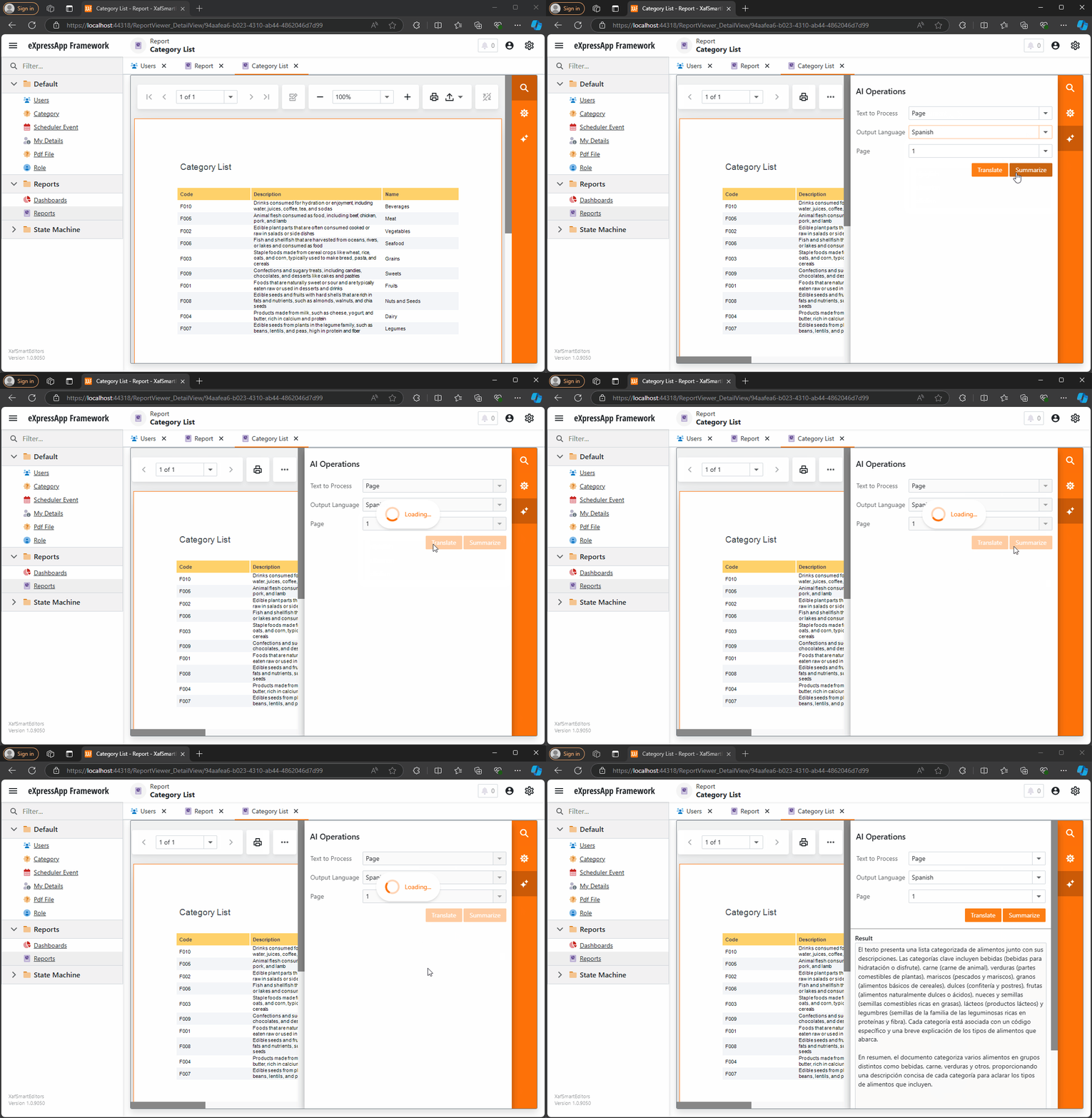
This blog post explores how to integrate AI-powered enhancements into DevExpress Reporting using Blazor. It walks through the setup process, including NuGet package references and configuring AI behavior for XtraReport. With easy-to-follow steps and code snippets, you’ll learn how to leverage AI features like summarization in your reports effortlessly.
Integrating DevExpress Chat Component with Semantic Kernel: A Step-by-Step Guide
Integrating DevExpress’s chat component with the Semantic Kernel for AI-powered chat completions is a game-changer. This step-by-step guide shows how to set up an intelligent chat interface using OpenAI and .NET. Learn how to combine these technologies and bring dynamic, context-aware conversations into your applications effortlessly!

Memory Types in Semantic Kernel
Semantic Kernel simplifies integrating AI models into your applications, with chat completions being the most common interaction method. Temporary memory, managed by the ChatHistory object or a string argument, is lost once the host class is disposed. In the next article, we’ll explore long-term memory options for more persistent solutions.

Enhancing AI Language Models with Retrieval-Augmented Generation
Exploring Retrieval-Augmented Generation (RAG), this article delves into how it revolutionizes AI language models. RAG merges language generation with external data retrieval, enhancing response accuracy and relevance in various sectors like customer service, education, healthcare, and media.

Machine Learning and AI: Embeddings
In the realms of machine learning (ML) and artificial intelligence (AI), embeddings play a crucial role. They transform complex, high-dimensional data into more manageable low-dimensional vectors, preserving essential properties. Embeddings are particularly vital in natural language processing (NLP), enabling ML models to effectively interpret text. Their creation involves sophisticated models like Word2Vec and CNNs, trained on extensive data to capture nuanced features. This article delves into the fundamentals of embeddings, underscoring their significance in advancing AI technologies

ADO The origin of data access in .NET
.NET communicates with a database using ADO.NET, which provides a set of classes and interfaces for accessing and manipulating data stored in a database. ADO.NET supports various database systems, including relational databases and XML databases. ADO.NET uses the following protocols to communicate with a database: 1. OLE DB (Object Linking and Embedding, Database) – This […]